JAR Annual 2015 Available for Pre-Order

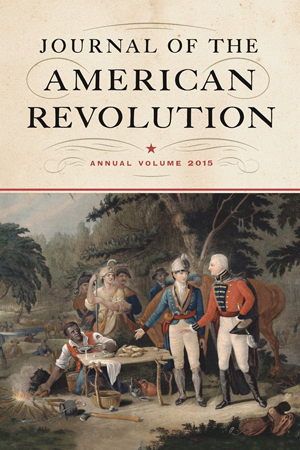
JAR2015_300x450The 2015 edition of the Journal of the American Revolution is now available for pre-order.

Every year, Westholme Publishing releases a reprint collection of essays that first appeared on the Journal website. This year’s volume includes my essay about the whaleboat raiding that occurred on Long Island Sound, where Patriots and Loyalists alike gave as good as they got:

“[T]wo boates crossed on the fourteenth instant,” wrote Caleb Brewster to New York governor George Clinton in the summer of 1781. “[They] went up about twelve at night to the houses of Capt. Ebenezer Miller and Andrew Miller, demanded entrance which was granted, as soon as the door was opened they demanded his arms which he gave up; his son hearing a noise below stairs got up out of bed shoved up the chamber windo. One of the party without ever speaking to him, shot him dead in the windo …”

During the Revolution, American Patriots employed a number of tactics to overcome their extreme disadvantage in the face of the overwhelming power of the British navy: a Continental navy, state navies, and privateers (some with Continental commissions and others commissioned by states). The whaleboat raiders — or “armed boats,” as they were called at the time — were a low subclass of the state-commissioned privateers, and as I point out in my essay, it’s questionable whether many of the raiders had commissions at all. In the chaos of war, the only equipment you needed to go robbing and pillaging on the opposite shore was a boat and some buddies, and if New England in 1776 was anything like New England in 2015 where every third house has a tarp-covered boat in its driveway, then this was not a high benchmark to reach. It probably attracted some men of dubious character.

The Annual Volume 2015 also includes essays from such notables as J.L. Bell, Benjamin Huggins, and JAR editor Hugh T. Harrington. Out in May, it makes a great Father’s Day gift!

The Mob Is Fickle

The Passive Voice is one of the few corners of the Internet where it’s worth reading the comments. In discussing a Salon interview with Jon Ronson, who wrote a book about survivors of social-media lynchings like Justine Sacco, a commenter referenced an attack on Andrew Smith. Smith, an author of YA books aimed at boys, was tarred and feministed after saying this:

I was raised in a family with four boys, and I absolutely did not know anything about girls at all. I have a daughter now; she’s 17. When she was born, that was the first girl I ever had in my life. I consider myself completely ignorant to all things woman and female. I’m trying to be better though.

I write about men and boys because I grew up with three brothers and I don’t know much about women and girls. I could freely say the same thing: my only sibling is a brother and my only friends growing up were boys, which is perhaps one reason why I mostly failed at dating as a teen; and as a married man what I know today about women wouldn’t fill the back of an envelope. But admitting that means I could just as easily be tied to the same stake as Smith, assuming anyone knew who I was.

This comes only days after another writer quit Goodreads in response to the Kathleen Hale brouhaha because — she was afraid of being stalked? A social-media assassination? I’m not sure; all I know is that even though both parties in the Kathleen Hale mess were female, somehow women are being targeted, and she was afraid it would happen to her.

(I admit the Hale story is bizarre in its mutual obsession; reading it is like watching Dracula and the Wolfman fight, although it’s enlightening that the profile of her troll — a physically sick or weak person working a monotonous, low-income job — fits that of many serial killers.)

A common complaint I read from agents and publishers is that many authors don’t have a platform before they show up on their doorstep with a manuscript. Of course, everyone can only offer advice on how to develop that platform in hindsight: just look at Trevor Noah, whose comedic work scored him The Daily Show gig while simultaneously inciting excoriation for jokes that fell flat years before anyone had heard of him. Twitter is chock full of Dalai Lamas who can tell us after the fact which gags Noah should have written and which ones he shouldn’t have, but in the long months and years of building a career, those same sages are always like Tenzin Gyatso in Tibet: absent.

Contrast Noah with Kristine Katherine Rusch:

Personally, I believe that a writer’s politics and religious beliefs (including beliefs about a favorite genre) should remain off-social media if at all possible, and that arguments in favor of one thing or another should be made in person, if at all.

I think it’s more important to incorporate your worldview into what you write and let the readers decide whether or not they want to read your work than it is to win an argument that will seem quaint fifteen years from now.

There’s certainly wisdom in restraint and choosing your battles, but advice like Rusch’s is a call to quietism and in any event impossible for those of us who straddle the worlds of nonfiction and fiction.

Thus we authors and writers, forced to develop our platforms, must also choose between self-imposed silence and abandonment of social media on one hand, of all-consuming insecurity like Hale’s on another, or of following the examples of Smith and Noah on a third, of trying to build the platform one day at a time, knowing that griefers lurk on the periphery, eager to burn the whole thing down the moment you drive one dissatisfactory nail into the wood. Or, in Smith’s case, of simply stating a truth about yourself.

Top photo by Caelio CC BY-SA.

Condemning the Past

Gordon S. Wood on the criticisms levied by academics against his fellow early American historian and mentor Bernard Bailyn:

College students and many historians have become obsessed with inequality and white privilege in American society. And this obsession has seriously affected the writing of American history. The inequalities of race and gender now permeate much of academic history-writing, so much so that the general reading public that wants to learn about the whole of our nation’s past has had to turn to history books written by nonacademics who have no Ph.D.s and are not involved in the incestuous conversations of the academic scholars.

Wood is certainly not happy with this state of affairs. Yet it’s gratifying to see him correctly diagnose the disease — that academics wallow in “condemning the past for not being more like the present” — even if we disagree about the prescription.

America’s Creeping Confucianism

By now you’ve probably heard about the New Jersey antiques collector facing 10 years in prison for possessing an unloaded 1765 flintlock pistol. Earlier that day, the man and his friend had bought the gun from an antiques dealer in Pennsylvania:

On the way home, the pair were pulled over by a local sheriff. According to Van Gilder, the detaining officer told him that he wanted to search the car, and threatened him with dogs if he refused. “I didn’t mind,” he tells me, but he wanted to make sure that the officer knew that there was a flintlock pistol in the glove compartment, and that he had just purchased it. “Oh, man,” Gilder says. “Immediately, he wanted to arrest me. But when he called the undersheriff, he was told, ‘No, it’s a 250-year-old pistol; let him go.'”

The officer did as he was told, and gave the pistol back. The next morning, however, he came back — “with three cars and three or four sheriffs.” Van Gilder says, “He told me, ‘I should have arrested you last night.'” So he did. “They led me away in handcuffs” and, at the station, “chained me by my hands and feet to a cold stainless-steel bench.”

The man, Gordon Van Gilder, is a retired English teacher who lives in Millville, NJ, which incidentally is quite close to where I grew up. The geography is an added level of absurdity in this case: Millville is extremely rural and piney. By no stretch of the imagination could the pistol be considered a danger in a densely populated urbanscape; Van Gilder could probably walk out his front door and go full Aaron Burr without hitting anything besides a white cedar or a snapping turtle.

The I-told-you-so attitude of the officer highlights the growing Confucianism in American law enforcement. To Confucius, all crimes could be categorized. Context of the crime was to be eliminated and was even seen as undermining society; circumstances were to be stripped away from hypotheticals like, “Would you steal medicine to save your dying child?” leaving only the theft before the judge. What punishment to deliver was merely a matter of establishing what crime had been committed. Confucianism is characterized by its “respect for authority, hierarchy and social order,” in the words of one apologist. It is the ethics of despotism, which is why it’s been popular in China for millennia.

The fact that the officer threatened to unleash the hounds on a couple of old coots driving down a country road is reminiscent of a story Bill Lee, the cover artist for Samuel Smedley, Connecticut Privateer, told me about him and some of his WWII buddies being boarded and searched by the Coast Guard in Bridgeport Harbor — apparently our brave USCG thought a boatload of Normandy Nazi killers was “suspicious.”

The context of Van Gilder’s situation — harmless history buffs returning from an antiques dealer with an antique — is superfluous. The Confucian officer is sure a crime has been committed and it only remains to determine which one. This is precisely why police departments discriminate against hiring officers with high IQs: they want somebody with a binary mind who won’t consider bigger questions. Just like an insect’s brain is simply a series of on/off switches — is this food? is this an enemy? — the New Jersey sheriffs only care if the flintlock is contraband or not. Today a legislature could outlaw bread and tomorrow cops would arrest everyone with a loaf or baguette on their pantry shelf, never considering the sense or wisdom behind the law. Beetles and ants are not philosophers.

The icing on the cake is that the pistol will probably be destroyed — or more likely find itself on the mantel of some petty Cumberland County potentate. If only New Jersey could be more like Connecticut and put those sheriffs out of work by eliminating county governments.

Local Cop Rapes Teen, Gets 2.5 Years

This happened last month but I just learned about it: William Ruscoe, a Trumbull police officer who was a member of the SWERT team that murdered Gonzalo Guizan during the May 2008 raid in Easton, CT, was sentenced to 30 months in prison for raping a teenager. Ruscoe’s plea bargain called for five years prison time in exchange for him pleading guilty to second-degree sexual assault. Instead the judge gave him half that. Why? Because some animals are more equal than others, of course:

During the emotion-packed hearing the victim urged the judge to impose the plea bargained 5-year prison term on Ruscoe.

“I was completely betrayed by someone I looked up to as a role model,” the girl told the judge. “I still wake up in a pool of sweat after having a nightmare where I yell stop and no, the two words I yelled that night at him.”

State’s Attorney John Smriga added that five years was the appropriate sentence.

“It’s not that he (Ruscoe) just had a bad day, this was an action that was planned out,” he said.

But [Superior Court Judge Robert] Devlin, while acknowledging that children need to be protected said he was giving Ruscoe credit for his years of good service with the police department.

As if after Ferguson and Eric Garner anybody needed more proof that there is one rule of law for police and another for the rest of us. I know that plea bargains aren’t set in stone and I’ve read several stories where defendants received harsher sentences than what they agreed to, but I’ve never read about someone being sentenced to less than the prearranged jail time. William Ruscoe is a monster. And frankly, so is Judge Devlin.

Via Simple Justice.