
Jacob Sullum on the government shutdown:
The saddest scenario envisioned by the Times involves a Cincinnati woman who is driving to Washington, D.C., on Friday with her family and plans to visit the Smithsonian Institution. When she gets there, the Times gravely informs us, she may be greeted by paper signs that say “Closed Due to Government Shutdown.” Tragic as that would be, I have to ask why the hell the government needs to run a set of museums that paying customers are so eager to visit. Ditto the National Zoo and the national parks, which also will close temporarily in the event of a shutdown. If people really value such facilities, they would be willing to pay for private versions of them, whether as customers or as patrons. If they don’t, how can it be right to forcibly take their money and use it for these decidedly nonessential purposes?
There is no doubt in my mind that government transparency is aided and abetted by the maintaining of archives, so I see no contradiction between supporting the Smithsonian and my belief in low taxes. Written documents can tell us a lot about what occurred in the past but so can material culture. That is the difference between history and archaeology. If we agree to preserve the plans of how to build an Apollo rocket capsule, then is it so strange to also preserve the capsule itself? The only quibble is what exactly should be preserved. The Wright Flyer or a fossilized T-rex skull is more relevant and important than an inaugural gown will ever be. Or maybe not. We can argue over criteria.
That said, I don’t have a problem with the Smithsonian charging a modest admission fee to offset some of its costs. But there’s no way user fees could ever cover the expense of curating its massive holdings.
The National Zoo is more problematic. One imagines a likewise biological archive where visitors could experience the indigenous fauna of the 50 states, but in reality there’s not so much as a bison burger in the National Zoo cafeteria. The place is instead a menagerie of pandas and elephants and kangaroos — whatever animals have been dropped on us by foreign dignitaries. It’s a run-down, random mishmash and it should be completely privatized.
As for national parks, battlefields, and so on: I don’t lose sleep over them. If the day ever comes when the most egregious abuse of government is taking our tax money to spend on public parks and libraries, then libertarians have won.

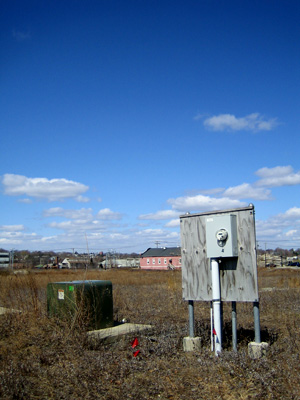 The area, originally known as Mamacock, was a peninsular pile of rocks in the Thames River just south of New London until the American Revolution. New London was then Connecticut’s most important harbor, deep water sheltered three miles upriver from Long Island Sound. It was also the state’s privateering capital. To protect it, Governor Jonathan Trumbull and his Council of Safety ordered a fort to be built on Mamacock overlooking the harbor. Together, Fort Trumbull and another fort on the opposite bank in Groton, called Fort Griswold, maintained a protective screen across the harbor. Records show several examples of American vessels, hotly pursued by British warships, saved by the aegis of the forts’ cannons. The reality was more bark than bite since both forts were undergunned and undermanned, but the British didn’t know that. In September 1781, Benedict Arnold (originally from Norwich, just upriver from New London) burned the town by landing forces on both sides of the river’s mouth, marching north, and capturing the forts from behind.
 But the citizens of New London do have to worry about jobs and schools, which is why it’s so unfortunate they couldn’t be better served by their government. Never mentioned in any of the media coverage of the court battle was how derelict the downtown area is. Walking along Bank and State Streets, I estimate that one-third to one-quarter of the storefronts are empty and available for lease. It’s been that way for years. Most of the businesses are bars, catering I suppose to the students of the Coast Guard Academy, Connecticut College, and the handful of other colleges in town (I’ve never been in downtown New London on a Friday night, but I always imagine fistfights in the street and sailors flying through plate-glass windows). But instead of redeveloping the downtown with a hotel or condo units or office space — all of which there’s plenty of room for — the NLDC and the city government tarred Fort Trumbull — that’s what? a half-mile away? — as a blighted ghetto and destroyed a functioning residential neighborhood.
 In 1780, some privateer friends and relations of Samuel Smedley found themselves jailed within the notorious British prison ship Jersey at what is now the Brooklyn Navy Yard. It was enough to get their Irish up. From the journal of William Wheeler:

