
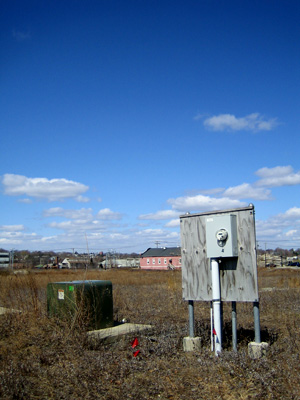
This is the Fort Trumbull neighborhood of New London, Connecticut almost six years after the Supreme Court decided money talks and personal property is bullshit. The “municipal development plan” by the New London Development Corporation, the private developer behind the debacle, promised a 250-room hotel, up to 80 condominiums, 450,000 square feet of office space, and a national Coast Guard museum. But in the year 2011, the NLDC is bankrupt, Pfizer has moved across the river to Groton, and the city of New London doesn’t even own this land.
 The area, originally known as Mamacock, was a peninsular pile of rocks in the Thames River just south of New London until the American Revolution. New London was then Connecticut’s most important harbor, deep water sheltered three miles upriver from Long Island Sound. It was also the state’s privateering capital. To protect it, Governor Jonathan Trumbull and his Council of Safety ordered a fort to be built on Mamacock overlooking the harbor. Together, Fort Trumbull and another fort on the opposite bank in Groton, called Fort Griswold, maintained a protective screen across the harbor. Records show several examples of American vessels, hotly pursued by British warships, saved by the aegis of the forts’ cannons. The reality was more bark than bite since both forts were undergunned and undermanned, but the British didn’t know that. In September 1781, Benedict Arnold (originally from Norwich, just upriver from New London) burned the town by landing forces on both sides of the river’s mouth, marching north, and capturing the forts from behind.
Fort Trumbull was nothing more than an earthworks and stockade during the Revolution but later, during the 19th century, it was developed into a stone-walled citadel. Today the complex is a state park with gorgeous views overlooking the river.
The homes outside the park were routinely labeled a “working-class neighborhood” by media during the Kelo v. New London court battle, “working class” being shorthand for “pre-gentrified” or “non-McMansiony.” It’s not a wrong assessment but all of New London could fall under that description. New London is actually one of my favorite towns in Connecticut. Unlike a lot of coastal municipalities in this state, the city actually feels like a New England seaport, full of crying seagulls and hilly streets and Federal-style houses, some well-kept and others that could be great again. New London has been bleeding population since 1960, making it feel big and empty (I never have a problem finding a parking space), but with a shabby bohemian atmosphere of murals and galleries and food co-ops and vintage-clothing stores holding it together. I could spend days snapping photos there, and if I were younger and didn’t have to worry about jobs or my sons’ schools, I might even move there.
 But the citizens of New London do have to worry about jobs and schools, which is why it’s so unfortunate they couldn’t be better served by their government. Never mentioned in any of the media coverage of the court battle was how derelict the downtown area is. Walking along Bank and State Streets, I estimate that one-third to one-quarter of the storefronts are empty and available for lease. It’s been that way for years. Most of the businesses are bars, catering I suppose to the students of the Coast Guard Academy, Connecticut College, and the handful of other colleges in town (I’ve never been in downtown New London on a Friday night, but I always imagine fistfights in the street and sailors flying through plate-glass windows). But instead of redeveloping the downtown with a hotel or condo units or office space — all of which there’s plenty of room for — the NLDC and the city government tarred Fort Trumbull — that’s what? a half-mile away? — as a blighted ghetto and destroyed a functioning residential neighborhood.
Which is now just fields of weeds and rocks. The city doesn’t even own the weeds and rocks. The NLDC was supposed to turn over the titles to the city once the demolition was complete but they never did; and the city is reluctant to pursue action because then they would have to mow the weeds and be responsible if someone fell off the rocks. I suppose theoretically the NLDC pays property taxes on the lots — but since they’re bankrupt, that money is just hash marks on paper. Eminent domain is touted as being for the public good. But in New London, the public paid taxes so the government could steal their own land which they didn’t even get.
Today the only residents of Fort Trumbull are a clowder of stray cats. Somebody built a little scrap shelter for them on a rocky mound. There’s a water dish and I met some moms and kids who had come to feed them. The cats of New London are better off than the people.


