Beyond the Sea

20,000 Leagues Under the Sea

J.D. Tuccille of Reason.com has rounded up the latest denunciations of seasteading — the concept of autonomous man-made islands:

Criticism of seasteading now takes on an oddly strident tone, and from unusual sources.

A week after reporting on DeltaSync’s Seasteading Implementation Plan, Global Construction Review, an online publication of Britain’s Chartered Institute of Building, ran an attack on the idea as an abandonment of social responsibility. The publication’s editor, Rod Sweet, took time away from the business of covering engineering and construction to “to lay bare the motivation behind the movement—the libertarian urge for the freedom to profit without having to contribute to the social conditions that make profit possible.”

In recent years there’s been a trend toward attacking Information-Age developments based not on the deficiencies of the technology or issues but rather on the perception that said plans are libertarian schemes to avoid taxes. Bitcoin and other cryptocurrencies? Libertarian criminality. Secession — not from the US, but into smaller, more responsive state or municipal bodies? Perfidious libertarian tax evasion. Seasteading? A misguided dream by “adherents of ‘libertarianism,’ that peculiarly American philosophy of venal petty-bourgeois dissidence.” This last written by none other than China Mieville, the Marxist don who moonlights as a successful science-fiction writer.

Any news story about seasteading invariably descends into Rapture jokes in the comments but there’s nothing inherently libertarian about man-made islands. You could just as easily use the technology for a floating kibbutz as for an art-deco Galt’s Gulch. Even one of seasteading’s major advocates has said, “We can’t build libertopia … Whatever we build will have to have security forces who will bust in your door if they think you’re designing nuclear weapons or funding terrorism.”

Regardless of seasteading’s practicality (while cautiously intrigued, I have several unanswered questions about it myself), it is disturbing that scientific futurism is met so reactionarily — especially by readers and writers of speculative fiction (to see examples by readers, check out the comments sections of any io9 article on these subjects). Setting aside the questions of when and why did libertarians become bogeymen to the left (Radley Balko keeps a list), what the hell happened to sci-fi? Are Martian colonies not dismissed as libertarian conspiracies because they are decades away while Bitcoin, etc. are happening now or very soon? When did imagining a better world of tomorrow go from Heinlein to thought-crime? After all, the first proponent of oceanic utopianism was the 19th-century hero of the left, Jules Verne, who inspired those seeking an escape from the -isms of capital and czar:

“Also,” [Nemo] added, “true existence is there; and I can imagine the foundations of nautical towns, clusters of submarine houses, which, like the Nautilus, would ascend every morning to breathe at the surface of the water — free towns, independent cities.”

I think it’s more likely that, in the words of another 19th-century author, these same writers and readers, so eager to throw out the old gods, have sworn loyalty to another idol, and to turn your back on it is heresy.

LITCHerally the Best Guest Post Ever

You're litcherally my favorite person!Matt Mitrovich asked me to write a guest post at Alternate History Weekly Update about my second forty-second career as an ebook-cover artist. I don’t think I’m qualified to write a how-to article on tying shoelaces let alone designing ebooks, but I scribbled some criteria and design ideas for his readers anyway. Matt has been phenomenally helpful in promoting Altered America, which in turn played a large role in its sales spike a few weeks ago.

Rereading said post, I find its upbeat tone almost unrecognizable to me, particularly in the last graf. I’m a much different person than I was a few years ago. A big part of that is due to our house, which is very near completion (the last contractor finished today). It has been a transformative 11 months. I’ve become even more Ron Swansonish about institutions — banks, insurance companies, governments — but more Chris Traegerish about individuals. Throughout the process, so many faceless bureaucracies were lined up against us yet our skins were saved time and again not just through our own tenacity, but also because of the effort and understanding of all the people who’ve worked on the house or supported us. If I go through the day without having to extinguish some kind of brushfire crisis — What’s that? You’re NOT cancelling my homeowner’s insurance for arbitrary reasons? Hooray! — then it’s a great day. I think that optimism has spilled over to how I feel about others and their projects and ambitions.

Down on the Rio Grande

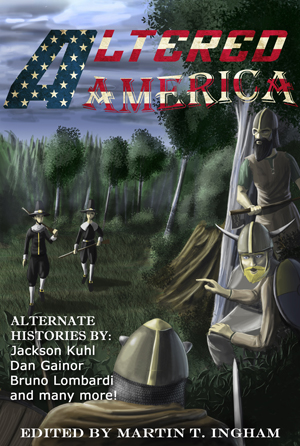
Altered AmericaMy story “Rio Grande” appears in the new alternate-history anthology, Altered America. Gambling gunfighter Lorenzo seeks vengeance against a card sharp in the Republic of the Rio Grande, an independent country based on the economic principles of Frederic Bastiat:

“When the Republicans defeated the Mexican army at Morales, everyone knew it was only a matter of time before Mexico tried again. They realized our little breakaway estado could only be held by force. Force means men. So they encouraged homesteading to grow the population. They tried various policies for a few years but nothing worked. Everyone wanted to go to California instead. Finally President Jordan discovered the writings of a French philosopher named Bastiat. This philosopher advocated free exchange. No taxes. No tariffs. No customs. A strictly confined government. ‘Law is organized justice,’ said the philosopher — anything beyond that is perversion. So they scrapped everything and started over with a new constitution based on his writings and principles. They advertised it in all the eastern newspapers. Cheap land. Live tariff free. Women can vote. And where there are women, there are men and soon enough children who grow up to defend against Mexico. Then there weren’t enough branches in the trees to beat back the settlers.”

“But how do you pay for the judges and the marshals? Who builds the courthouses?”

“The philosopher wasn’t against taxes so much as their unfair and arbitrary application,” said Valasquez. “So to keep everyone honest, there are none to begin with. Citizens can make donations. But that’s exactly how Jordan managed to convince his caudillo supporters to agree to the constitution. It meant only self-sufficient people could afford to be judges and marshals.”

“Only the wealthy, you mean.”

“How is that worse than America?”

Alien Space Bats maybe, but I’ve often wondered why banana-republic rebellions usually take such a distinctly left-hand turn. The answer, I suppose, is Marxism’s empty pledge to eliminate the elite classes, a mistake based on the assumption that class derives from economic systems rather than being a natural by-product of state-level civilization.

In any event, “Rio Grande” isn’t for or against libertarianism so much as it is a stab at that most pernicious of modern ideologies, utopianism. Earlier this week at Reason.com, author Anne Fortier noted the power of historical fiction:

To the freedom-friendly novelist, one further advantage of historical fiction is that the entire history of mankind is jam-packed with tragic examples of what Hayek called “the fatal conceit” and the corrupting effects of power — especially state power.

It’s worth reading her whole essay, though I’m not sure what business Fortier has throwing speculative fiction under the bus after writing a whole book about a mythological matriarchy (for all of her self-satisfaction, it seems Fortier hasn’t learned that genre — the difference of where you’re shelved in the bookstore — is simply packaging). But she’s right: history shows that power disparities are inevitable once a certain complexity of social organization is reached, and the key is not a false promise of eradicating those disparities but rather blunting power so that it does the least harm.

You can purchase the whole anthology here — I’m happy to report the Kindle edition has seen a steady burn of sales since its release — or read my complete story for free here. And if you enjoyed the antho, please leave a review at Amazon or Goodreads.


Samuel Smedley: Man of Fairfield!

Samuel Smedley, Connecticut PrivateerSaturday I’ll be at the downtown Fairfield University Bookstore to present about Fairfield’s Revolutionary past. Along with Rita Papazian — two for the price of free! — I’ll be discussing Samuel Smedley, Caleb Brewster, and the 1779 burning of Fairfield. The talk runs from 1-3pm on the second floor.

And if you’re a fan of Caleb Brewster, the first episode of Turn debuts this Sunday night on AMC. The five-part series dramatizes the events of the Culper spy ring, the famous Patriot intelligence network that developed in New York and Long Island after the city’s fall to British troops and Loyalists.

Brewster, a native of Setauket before decamping across the Sound to Fairfield, was a crucial link in the ring, ferrying information about British goings-on from Long Island to Connecticut and thence to General Washington. And as if he wasn’t enough of a bad-ass already, Brewster was also handy in a fight. The Journal of the American Revolution has seen early episodes and given it eight Huzzahs.

Solar Scuffle at Seaside Park

Today at National Geographic’s Energy Blog, I have a story about Bridgeport’s environmentalist-on-environmentalist dog pile over a plan to situate a 9,000-panel solar array atop the landfill in Seaside Park:

Torres believes the solar project should be sited elsewhere in the city. “It does not belong in a park. It belongs on any of the countless, countless unused or massively underutilized land owned by the city.”

According to the state Department of Energy and Environmental Protection (DEEP), Bridgeport has 17 brownfield sites totaling more than 185 acres. This doesn’t include any number of non-polluted but abandoned lots and buildings in Bridgeport, a phenomenon so ubiquitous that Connecticut Yankee Seth MacFarlane once used it to zing the city on Family Guy.

Anybody who’s ever driven through Little-Detroit-on-the-Sound knows the city does not lack space for projects such as this. The real issue, of course, is that Bport doesn’t own any of those brownfields or derelict factories, so they’d have to lay some currency on the countertop before they could even think about siting the array anywhere but on park land. UIL sure as hell isn’t going to buy real estate for renewables.

I’m surprised Finch doesn’t want to put the panels on Pleasure Beach — it’s not like citizens will ever see a return on the $1.9 million appropriation to run ferries out there.