Quivira

Home of the Cliff Dwellers postcard
Home of the Cliff Dwellers, Mesa Verde, Colorado, 1898

“Quivira” was written in the fall of 2011 in that initial burst of fiction writing I had after Smedley was released. I spent much of that summer and autumn giving presentations and doing signings around Connecticut. During my off moments I still wanted to write but I didn’t have the time to focus on a new long-form project, which is why I had begun writing short fiction. It was a way to keep my knives sharp without the commitment.

Prior to “Quivira” I had been writing alternate histories and likewise it was intended to be an alt-hist until it somehow went sideways into a land of doppelgängers and American Indian mythology. Being so busy meant time was a recurring issue in my head; and, more specifically, how often there aren’t enough hours in a given day to get things done. To succeed at one ambition often means sacrificing another due to lack of time — it is the compromise of the clock.

What if those squashed ambitions returned to haunt you in a literal sense?

Eric Guignard accepted the story for his first anthology Dark Tales of Lost Civilizations, which went on to be nominated for a Stoker. Better still, we struck up a friendship and years later would work together on another project.
Mourning Dove

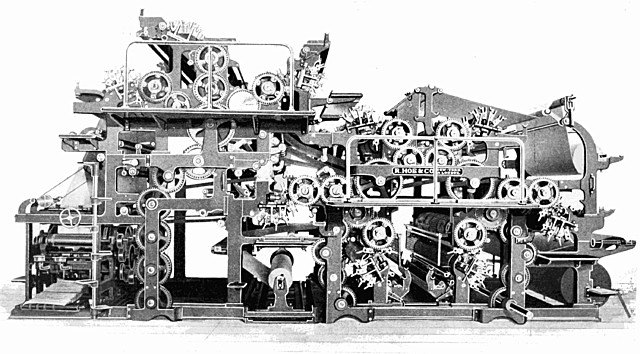
Printing pressWhen I was a kid my dad had a playback typewriter. As you typed a document the typewriter would perforate a tape of green paper. When you were done, you flipped a switch and fed the perforated tape back into the machine, whereupon it would automatically type a copy of the document — useful, I guess, in an era when copiers were reserved for big businesses and copy shops were far between. Of course, you had to type that initial document perfectly otherwise the tape would repeat a mistake in every copy, which to my mind restricted the machine’s utility to professional typists.

This strange artifact, so specific in time, sat large in my mind as I wrote “Mourning Dove,” which features a mechanical mashup of a printing press and a player piano. The story is a tight 3K, written late last year for Third Flatiron’s weird West anthology Principia Ponderosa.

A recurring thought at the time (you can maybe guess why) was whether knowing the hour and manner of your own death would be beneficial — you could live as if every day was literally among your last — or if the anticipation of death’s approach would be too anxiety inducing and therefore you would actively avoid knowing. Thing is, even in the absence of a prophetic machine we usually make one of these choices.

Story order is important to any collection, and I think as an opener for The Dead Ride Fast, the fast pace and relative brevity of “Mourning Dove” make for a solid tone setter.

The Dead Ride Fast

The Dead Ride FastRemember back in 2014 when I said I would publish a reprint collection of my short fiction the following year? Well, better late than never — The Dead Ride Fast will be available as an e-book next Tuesday.

The Dead Ride Fast collects six of my weird Westerns, all of them stories of existential dread on the 19th-century frontier.

I cannot express how much fun it’s been to put this book together.

There are many reasons why I wanted to publish under my own imprint. I try to live by P.J. O’Rourke’s maxim that a writer should always be paid at least twice for a piece of writing; and like the T-shirt says, What part of 70 percent royalties don’t you understand?

Yet what I enjoyed most was the absolute control over the entire product, from the cover to the typography to the interior layout. Writing can turn a little stale over time: you write something, it’s published, you receive a check. That two-beer buzz, so sharp when you’re in your early 20s, dulls as the years pass. The excitement I still feel when I write derives from the actual creation itself — the alchemy of writing and revision — but dwindles as soon as I send it off to the editor.

That thrill of creating, that alpha-to-omega electrification, was something I felt the entire time while assembling Dead.

If you want to know the technical nitty gritty of how I did it, Daddy Jack will tell you after the jump! jump!

Continue reading “The Dead Ride Fast”

What Matters Is What You Believe

As an epilogue to my last post about Twin Peaks (among other things), director and cowriter David Lynch recently made some comments about the series and the nature of ambiguity itself, both in art and real life:

When it comes to the final moments of this season, he said, “What matters is what you believe happened. Many things in life just happen and we have to come to our own conclusions. You can, for example, read a book that raises a series of questions, and you want to talk to the author, but he died a hundred years ago. That’s why everything is up to you.”

If Robert Aickman was to be resurrected as a filmmaker, he would be Lynch.

If It’s Tuesday, This Must Be New Colonia

The hubbub over Confederate has spurred Amazon to reveal that they’ve been developing a new alternate-history series of their own which likewise has its point of divergence in the 19th century:

In the back story of “Black America,” the Confederacy was defeated. But instead of enduring the painful eras of Reconstruction and Jim Crow, African-Americans received reparations. The former slaves and freedmen claimed Louisiana, Mississippi and Alabama, a nation known as New Colonia.

That nation has a “tumultuous and sometimes violent relationship” with the United States, which is described as both an ally and a foe.

Black utopianism? Now that’s what I’m talking about!

I have to wonder if Black America is a replacement for The Man in the High Castle, which is entering its third (and final?) season. Regardless, the possibility of independent nations occupying the geography of the real-life Lower 48 is an alt-hist concept I adore — I’ve used it more than once in my short fiction. Amazon, you had my curiosity but now you have my attention.