Publishers Have Pea Brains

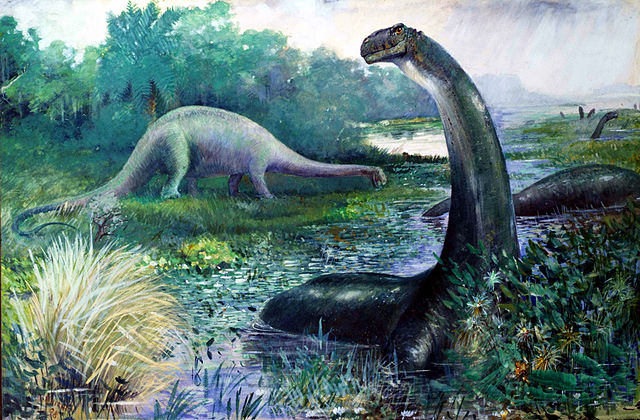
Brontosaurus by Charles R. Knight, 1897

After months of wondering whether the Amazon vs. Hachette dispute was over the pricing of e-books, Amazon has finally revealed that the fulcrum of the argument is indeed the pricing of e-books:

A key objective is lower e-book prices. Many e-books are being released at $14.99 and even $19.99. That is unjustifiably high for an e-book.

Even without knowing the exact details I’ve been on Amazon’s side since the beginning based simply on my belief that most publishers are idiotic criminals. No, I’m not just referring to the DoJ’s suit against Hachette and others for conspiring to fix e-book prices — by “criminal,” I mean many publishers are too stupid and lazy to earn their money sensibly, so like purse-snatchers they must resort to stealing it.

How else to explain the atavistic business model of publishing heavy, antiquated hardbacks for $30, then a year later a less-expensive paperback edition? Or delaying an e-book version until well after the print copies have laid on the bookstore tables? Or not offering e-books at all, even though sales of print books are estimated to be down 8 percent since 2008, the year after Kindle was introduced?

Consider these three personal anecdotes:

  • Earlier this month, it was announced that Arcadia Publishing would be acquiring The History Press, publisher of Samuel Smedley, Connecticut Privateer. All well and good. Yet buried in the Publisher’s Weekly article was this fact: although Arcadia has a catalog of 9,000 titles, only “about 4,000” of them are offered as e-books. The CEO explained, “Since Arcadia’s titles are heavily illustrated, it has been cautious in moving them into digital format.” Except the postcards and photos included in most Arcadia titles are already black-and-white, which means they would translate well to Kindle’s E Ink or a Nook, let alone a tablet. I can understand how the nature of Arcadia’s books might slow down the conversion process — but less than half their catalog? The article also notes, “nearly all of History Press’ titles are already sold as e-books.” Methinks Arcadia, raising their serpentine necks from the mire with mouths full of water weed, saw the comet tail in the heavens and sought to stave off extinction by very quickly diversifying their backlist.
  • While standing at the school-bus stop one day, my neighbor who works for a well-known publisher in New York mentioned his efforts to digitize some of the processes at the company. I asked, Is this part of a green initiative to use less paper? He said it was an attempt to use less paper period. He then went on to tell me that no part of the process for publishing a book at his company was digital, save for the copyediting — and that, he said, was a recent development. The author submitted a hardcopy manuscript, edits and additions were made in hardcopy, and eventually the whole thing was shipped off in a big box to the printer in Quebec who, as my neighbor said, “somehow makes sense of it.” I was gobsmacked; the process for Smedley was entirely digital. But then again, small companies like The History Press don’t have cash to waste like the big houses do. So authors: when the publisher tells you it can only spare an eight-percent royalty, now you know the other ninety-two percent goes to Dunder Mifflin.
  • Chaosium mainly designs role-playing games but they also publish a line of Lovecraftian fiction. I’ve been interested in checking out a few titles, if only to read (and support) my old pen-pal Jeffrey Thomas, whose work appears in some of their releases. Yet Chaosium doesn’t offer e-book editions of their fiction. At all. In the year 2014. Because plugging the completed manuscript into, say, Jutoh and spitting out a .mobi or .azw is just too tough. This week I wrote the company asking if they had any plans to offer e-books. I haven’t received a response.

Meantime, Amazon has had to teach the concept of price elasticity to Hachette, a giant multinational company:

It’s also important to understand that e-books are highly price-elastic. This means that when the price goes up, customers buy much less. We’ve quantified the price elasticity of e-books from repeated measurements across many titles. For every copy an e-book would sell at $14.99, it would sell 1.74 copies if priced at $9.99. So, for example, if customers would buy 100,000 copies of a particular e-book at $14.99, then customers would buy 174,000 copies of that same e-book at $9.99. Total revenue at $14.99 would be $1,499,000. Total revenue at $9.99 is $1,738,000.

What dark sorcery is this? Is this so-called “price elasticity” some new, overwrought theorem clawing its way out of the black pits of the Chicago school of economics? No, wait — price elasticity in regard to e-books has been bandied about since at least January 2010, at a time when self-publishers, wondering how to price their e-books and unencumbered by the publishing industry’s arch-conservatism, had a crash course in the subject and determined pricing lower was better.

Publishers like Hachette, by pricing e-books at $14.99 or $19.99, want them to be comparable to their paperback editions, which by their nature they cannot be and which the public, realizing this, rejects. And yet the dinosaurs insist because they perceive e-book editions as competitors against the print editions of the same title. They think the cheapest edition will cannibalize sales of other editions. While that’s definitely true of hardbacks, in my experience sales of paperback vs. e-book come down to preference. People like one or the other but both can live alongside. A frustration with Smedley was the nine-month delay between publication of the print and e-book versions; while promoting the book in 2011, I had many would-be customers ask me if it was available as an e-book. Alas, at the time it was not. Those were lost sales. But the publishers in their skyscrapers never see this, so they stagger the release of editions and try to hike the prices of e-books.

Unable to adapt either processes or economics, publishers — the large ones, anyway — instead resort to gouging readers, shafting writers with low royalties, and colluding to form trusts. Rather than hate the orange smile, I see Amazon as the asteroid that is cleansing the Earth of predatory gargantua, allowing the rest of us small, shrew-like mammals to rise.

Update: I added a link to a New Yorker article to illustrate a point above about cannibalizing sales, but the story criticizes Amazon on several other issues worth noting:

For one thing, he said, Amazon doesn’t actually get to decide what share of revenue publishers pay authors, a fact that the company is aware of. Its call for a thirty-five-per-cent share sounds nice, [literary agent Brian] DeFiore said, but it means little.

So how is that Amazon’s fault? That’s an indictment of Hachette, not Amazon.

DeFiore also pointed out that Amazon doesn’t quantify what lower e-book prices would mean for sales of physical copies of the same books. Authors who work with traditional publishers like Hachette tend to make more, per copy, from hardcover sales than from e-books. If cheaper e-books draw people away from hardcovers, that could hurt these authors financially.

Yes, usually authors do receive a higher royalty on hardbacks. (A conspiracy theory of mine: publishers offer higher royalties on hardbacks than on the paperback rights because they know damn well about price elasticity, and realize they stand to sell greater volume of paperbacks and hence make more money on them.) But, over time, how many $30 hardbacks do you think an author will sell compared to its $9.99 e-book counterpart? The conclusion in the above graf does not follow from its preceding sentences.

If lower e-book prices were to eventually destroy the market for physical books entirely—or even shrink it enough so that it wouldn’t make financial sense for traditional booksellers to publish them—that would help Amazon consolidate its power, which would ultimately be dangerous for authors.

I admit this is a legitimate concern. If we only read e-books and Amazon is the solitary stall in the marketplace, that would be bad. But again: whose fault is that? The reason we’ve arrived at this destination is because Amazon moved faster and more nimbly than legacy publishers; it’s the Year of Our Lord 2014, and publishers can’t decide on a strategy for e-books or, like Chaosium, whether they should even offer them at all. As a writer of alternate histories, I can imagine a world where publishers established their own online market site to sell their products, bypassing Amazon altogether.

In the end, what confuzzles me most is why so many authors loathe Amazon for theft and bullying that has yet to occur while meanwhile defending publishers like Hachette, who are stealing from and bullying them right this minute.

Short News, Inebrious Fourth Edition

Ritmeier's C.W. Bitters, c. 1906.
Ritmeier’s C.W. Bitters, c. 1906, on display at the Wisconsin Historical Museum, Madison, Wisconsin.

Bracing Tonics. A CRM excavation at the site of a former Manhattan beer garden unveiled a trove of 19th-century bitters bottles. Bitters — tonics that combined herbs and spices along with a hefty dose of alcohol — were used as digestives and medicines at the time, even by otherwise abstinent teetotalers. From the relief writing on the bottles (which today are highly collectible), the archaeologists were able to track down the original recipes, which they then recreated and shared. Also worth noting: in the comments, an author plugged this apothecary recipe book.

Flipping my Lid. Speaking of cocktail books, I recently downloaded food writer Corin Hirsch’s Forgotten Drinks of Colonial New England, which includes recipes I intend to inflict upon our guests this July Fourth. I’ve always wanted to try flip. I’ve had switchel before, but didn’t care for it.

Columbia Uber Ailes. And in not-so-alternate-history news, Fox News reached through a tear and stole the logo for BioShock Infinite.

Vaya con Dios

You may be aware that a few years ago, I began writing 19th-century alternate histories as a literary vacation after Smedley. The series soon morphed into a stream of weird Westerns, ghost stories, and even a little steampunk; while simultaneously their creation transformed into a kind of palliative during the Years of Real-Estate Madness. Distracted by garages, painting, buying, selling, and restorations (not to mention paying employment), my attention was too fragmented to think about more books or even short nonfiction with its relevancy demands and expiration dates. The great thing about short fiction is I can write something, walk away for weeks, and then come back to pick up where I left it.

In keeping with a theme of endings and new beginnings, it’s time for Strange Wests to ride off into the sunset as I readjust my focus toward longer projects and nonfiction. Nobody has been more astonished than me by Wests’s reception from editors and readers. A bunch are in various stages of the pipeline, which means there’s more to appear, and never say never: I’m happy to write fresh material as the inspiration or invitation strikes. Plus I’ve come to depend on fiction writing as an analgesic too much to quit it altogether. I will still be writing historical shorts as time allows, only these, for the immediate future, will be set in New England.

My goal is to bundle Strange Wests into an e-book collection to be published in 2015.

Freeloaders

It never ceases to amaze me as a professional writer how often I am solicited to write for free.

For some months I’ve been having a simmering dispute with a longtime market of mine over language (or lack thereof) in our contracts, and for a while I believed the matter resolved. Then this week it erupted again.

Without going into the nitty-gritty, the company basically said to me, Jackson, we’ve enjoyed your work so much all these years that instead of paying you, we want you to write for free. But don’t worry — if we happen to find any spare change under the couch cushions, we’ll think about sending some your way!

Unwilling to continue under their absolutely Mephistophelean terms, this past Wednesday I resigned in cold disgust.

Being a writer is like being a restaurant owner whose clientele is just as likely to sprint for the door, half-eaten burrito in hand, as to pay you. And yet while anyone — even the culprit, else why would he run? — recognizes dining-and-dashing as theft, no one blinks an eye at not paying a writer.

The writer, the artist, the photographer is the first to initiate the chain of commerce but the last to benefit from it, the first to act but the last to be paid.

The majority of my career has been spent freelancing and yet the bulk of my income has always been from web-related services, not writing. The few individuals I’ve known who wrote freelance full-time lived in near poverty. The gravest problem with freelancing is not the low pay — many jobs pay terribly — but the erratic or late payments, making it impossible to depend on them to cover bills (although Mrs. Kuhl is quick to point out that many companies suffer from late or non-payments; the difference is that bigger entities have the capital to ride it out or absorb the losses, whereas a freelancer — a company of one — feels the razor’s edge more sharply). Just ask this Columbia J-School grad, although for what it’s worth she can take solace in the fact I’ve run up much larger tabs than $1,200 with delinquent markets.

I am not a Harlan Ellison I-don’t-take-a-piss-without-getting-paid type but I believe in writing without payment in only two situations.

The first is if I’m promoting something — like, say, Smedley or an anthology I’m in. This is easy to double-check because generally the title of the thing I’m promoting is right there in the article. Whatever time and energy I’ve invested in such promotion is a marketing expense, a commercial sent across the airwaves that may, or may not, result in a sale of the thing. If I think my efforts have led to at least one ring of the cash-register bell, then I count myself ahead.

The second instance is when I’m trying to grow my platform or, to put it another way, promote my brand. Writing a personal blog pays dividends, if only to telegraph to readers that the cats haven’t started eating your corpse yet.

Where you have to be cautious is when you don’t own or control the content. There is a species of coprophage that will try to entice you to write “for exposure.” Any editor who uses the word “exposure” is a BS artist, because either their readership is too low for it to be worthwhile or it’s so big they could actually pay you in the first place. “Exposure” is the recompense offered by amateurs and thieves.

The big red flag is when an editor or publisher won’t pay but nonetheless charges readers for the content. A few months ago I was asked by an editor for permission to reprint an article of mine in an e-magazine she publishes for tablets and e-readers. The magazine is not free; in fact, its cost is comparable to other e-magazines on the market boasting much higher circulations. The only compensation offered was a link to my website. In sum, this editor is assembling a virtual magazine in her kitchen from contributions she hasn’t paid for — so her overhead is effectively zero — but charging a non-nominal price for subscriptions and single issues, and therefore all of the money she makes on the magazine is profit, or at least goes to pay the salary of her single employee: her.

Apparently, working for exposure is fine for some animals, just not for others.

Even if no money exchanges hands, I still have to question how much effort is spent growing my platform versus growing theirs. Frequently I’m asked to commit to regular contributions to other people’s websites. Half of me is flattered and the other insulted. Once in a blue moon I will scribble a post for John O’Neill at Black Gate, and even if my time is wasted doing so, based on what scant behind-the-scenes knowledge I possess, I can hardly complain I’m being taken advantage of. This type of writing is very dependent on circumstances and must be handled on a case-by-case basis, but my natural instinct is always in favor of my time, and hence the answer to regular contributions is always no, and to occasional articles a hard maybe.

While I wish the ending had been less acrimonious, I’m happy to have severed ties with the company. Installed in our gorgeous house with the renovations complete, Mrs. Kuhl and I feel that our lives are on a new trajectory, and we’ve been consciously embracing better habits and choices while simultaneously pruning dead wood.

I’ve been in this business long enough to understand there are rarely hard breaks or fast stops — writing is a series of waves, often overlapping, in which you write on a subject or for a market as it builds and crests but by the time it recedes, you are already surfing another flow.
Beyond the Sea

20,000 Leagues Under the Sea

J.D. Tuccille of Reason.com has rounded up the latest denunciations of seasteading — the concept of autonomous man-made islands:

Criticism of seasteading now takes on an oddly strident tone, and from unusual sources.

A week after reporting on DeltaSync’s Seasteading Implementation Plan, Global Construction Review, an online publication of Britain’s Chartered Institute of Building, ran an attack on the idea as an abandonment of social responsibility. The publication’s editor, Rod Sweet, took time away from the business of covering engineering and construction to “to lay bare the motivation behind the movement—the libertarian urge for the freedom to profit without having to contribute to the social conditions that make profit possible.”

In recent years there’s been a trend toward attacking Information-Age developments based not on the deficiencies of the technology or issues but rather on the perception that said plans are libertarian schemes to avoid taxes. Bitcoin and other cryptocurrencies? Libertarian criminality. Secession — not from the US, but into smaller, more responsive state or municipal bodies? Perfidious libertarian tax evasion. Seasteading? A misguided dream by “adherents of ‘libertarianism,’ that peculiarly American philosophy of venal petty-bourgeois dissidence.” This last written by none other than China Mieville, the Marxist don who moonlights as a successful science-fiction writer.

Any news story about seasteading invariably descends into Rapture jokes in the comments but there’s nothing inherently libertarian about man-made islands. You could just as easily use the technology for a floating kibbutz as for an art-deco Galt’s Gulch. Even one of seasteading’s major advocates has said, “We can’t build libertopia … Whatever we build will have to have security forces who will bust in your door if they think you’re designing nuclear weapons or funding terrorism.”

Regardless of seasteading’s practicality (while cautiously intrigued, I have several unanswered questions about it myself), it is disturbing that scientific futurism is met so reactionarily — especially by readers and writers of speculative fiction (to see examples by readers, check out the comments sections of any io9 article on these subjects). Setting aside the questions of when and why did libertarians become bogeymen to the left (Radley Balko keeps a list), what the hell happened to sci-fi? Are Martian colonies not dismissed as libertarian conspiracies because they are decades away while Bitcoin, etc. are happening now or very soon? When did imagining a better world of tomorrow go from Heinlein to thought-crime? After all, the first proponent of oceanic utopianism was the 19th-century hero of the left, Jules Verne, who inspired those seeking an escape from the -isms of capital and czar:

“Also,” [Nemo] added, “true existence is there; and I can imagine the foundations of nautical towns, clusters of submarine houses, which, like the Nautilus, would ascend every morning to breathe at the surface of the water — free towns, independent cities.”

I think it’s more likely that, in the words of another 19th-century author, these same writers and readers, so eager to throw out the old gods, have sworn loyalty to another idol, and to turn your back on it is heresy.