Mourning Dove

I have a weird Western called “Mourning Dove” in the anthology Principia Ponderosa, now available.

She rose and walked to the press. “My husband started this newspaper to compete with the other established dailies in town. Every one of them printed a single edition per day. He realized he could gain an advantage by running two editions every day, and jump the competition by putting a morning edition on the streets for folks to read while they ate their bacon. But publishing two newspapers every single day is hard work, and doesn’t leave time for much else. So he invented this press to write the morning edition for him.” She patted the metal. “Thing is, he went ahead and somehow made a machine that wrote news before it happened, saving him the trouble of having to write about it afterwards.”

Certain recent aspects of my personal life have entailed me staring through a telescope into my future and I haven’t always liked what I’ve seen. I asked myself, Would anybody really want to know what lay ahead if they could?

Principia Ponderosa is available for Kindle and in paperback. The art above isn’t the cover; editor Juliana Rew used it for flavor when she sent around her submissions call and I love its digital whimsy, located somewhere between deco and 16-bit.

Black to the Future

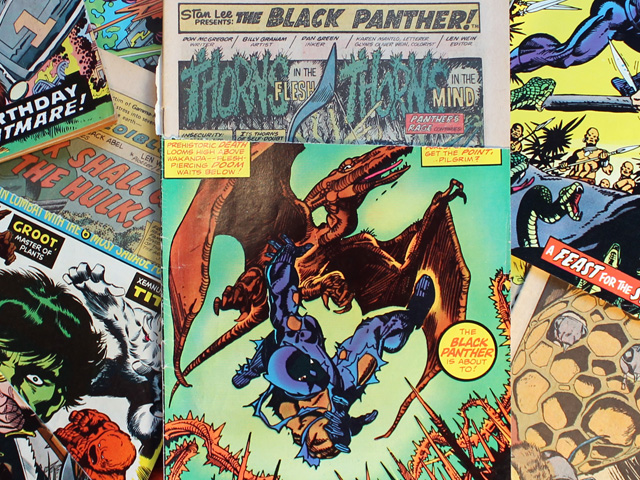
Over at Electric Literature, you can read about my childhood fascination with Marvel Comics’ Black Panther, and more specifically with his native land of Wakanda:

Black Panther is a hero in the Bruce Wayne or Tony Stark mold, a super-wealthy bachelor who uses science and athleticism to pound on bad guys. There are no secret identities — everyone knows who BP is: he’s T’Challa, the king of the African nation Wakanda, which is a mix of grass huts, deep jungle, and 1970s futurism.

The essay is a departure from my usual stuff, very loose and free floating, a sepia stream of consciousness about comics and growing up in a household where futurism was literally just laying around on tables or bolted to the roof. Whereas Panther’s color resonated with many black readers, it was the setting that captured my imagination, and still does: I nearly jumped out of my seat at the brief glimpses of Wakanda at the tail end of this year’s Captain America: Civil War.

As of this writing my essay has received 20 retweets and a dozen likes on Twitter, more than my book ever did, suggesting maybe I should write about pop culture more often. Unfortunately I’m poorly qualified for the job: I generally hate TV (some exceptions may apply), I can count the frequency I go the movies in a year on one hand, and the number of video games I’ve played to completion since 2011 tallies at exactly three. I love music but not being a musician myself I feel I lack the vocabulary to adequately speak about it. Which leaves book blogging, something I’m hoping to do more of in the new year.

Rereading my old BP comics within the full and complete context of “Panther’s Rage” has been gratifying, with Wakanda coming across as smaller than I remember (the sci-fi technology is largely confined to T’Challa’s palace) and yet bigger (more dinosaurs! snowy mountain wastelands chock full of yetis!). It’s interesting being at an age now where I can experience a phenomenon both as contemporary futurism and as retrofuturism. Something like Vernean steampunk will forever be out of reach as a potentiality and exists only for us as a quaint, even naive, vision of how things were supposed to be; but by simply living past tomorrow we can experience both the very real possibility and the hindsight of existing in what invariably turns out to be a different future.

I was recently talking to my dad about the solar panels on his house, which are solely for heating water. When I asked him whether photovoltaic panels were available in the 70s, he told me no, not commercially — the technology was in its infancy. And yet as we spoke while driving through the streets of his town, we spotted several houses with PV arrays on their roofs. Wherever you go there you are, but almost never where you thought you’d be.

I’ll be there on opening day in 2018 when the MCU Black Panther movie drops, and I’m sure I’ll have many opinions about it. Maybe I’ll even write some of them down. Meow.

Beer and Loathing

Justin Fleming, co-owner of Kelly Green Brewing Co.

I have a story at Atlas Obscura on how state licensing in New Jersey allows microbreweries to circumvent municipal liquor laws. The result: beer in my historically dry hometown of Pitman:

Drinking alcohol was never really illegal in Pitman–you just had to cross the town line to get it. While the state regulates alcohol in New Jersey, municipalities control the issuance of liquor licenses. Pitman has never issued licenses, resulting in an orbit of bars and package-good stores just outside the border. But in 2012, New Jersey amended its laws to allow microbreweries to sell their beer for consumption on the premises. Since these brewery licenses come from the state government, the microbreweries don’t require a local license to operate. In other words, they don’t actually need the town’s permission to make and serve beer.

Pitman is an odd place. Economically depressed, in my lifetime it’s never been able to capitalize on its main asset, which is its compact and navigable downtown. A big reason for this has been its pigheaded refusal to allow restaurants to serve alcohol. Pitman was commercially successful in the 1950s and 60s but when nearby malls began sucking shoppers away to Glassboro and Deptford, Pitman refused to adapt. It’s perfectly laid out to reinvent itself as a dining destination (something done by the Connecticut town I now live in) but it’s difficult, if not impossible, to entice quality restaurants when they can’t pair an IPA with a crab cake or a bottle of red with a steak, so instead Pitman’s downtown is a motley of pizza parlors and takeout joints which cater solely to locals, rounded out with thrift shops (I counted three) and other low-rent stores. If you’re from out of town, there’s no reason to visit Pitman — you’re better off going to Deptford mall-land and eating at a chain restaurant because at least you can have a drink on a Friday night. I mean, it’s not like a French restaurant is suddenly going to open in Pitman.

At least until Kelly Green arrived. The hesitancy that has hobbled Pitman for decades — one leg stuck in Glory Days, the other in economic reality — seems to be fading. One fourth-generation Pitmanite said to me, “I think Pitman owes its values to being dry.” Some values they are, too: few jobs (especially for teens), reduced assessments, diminishing property values. When Pitman began, temperance was rationalized for social reasons, as erroneous as those were; but now it has become a thing-in-itself, something justified because it’s always been. I’ve read enough newspapers and documents to recognize there was a problem with alcoholism and drunkenness in 19th-century America, although it was never the root of evil the Carrie Nation crowd believed it was — rather, it resulted from the grinding conditions of the time. Prohibition was a solution to an effect instead of a cause. Now we just keep it around for nostalgia’s sake.

Broadway Theatre, est. 1926, Pitman, NJ.

Anyway, I love Atlas Obscura and I’m thrilled they pubbed this story. I had been a fan of AO’s encyclopedia for years before finally joining in 2013, pushed over the edge by inaccuracies and untruths in their entry for Pleasure Beach — somebody was wrong on the Internet and I had to fix it! Later I was surprised they had nothing on any of the ghost towns in the Pine Barrens (those could fill an encyclopedia all their own) so I added Batsto. Eventually I want to add a few more Nutmeg sites but in the meantime I check their encyclopedia before every trip. Since David Plotz came onboard, AO has been publishing news and features as well, and their wry editorial voice is an anodyne to most travel sites. You can find me over there as JDK.

JAR Annual 2015 Available for Pre-Order

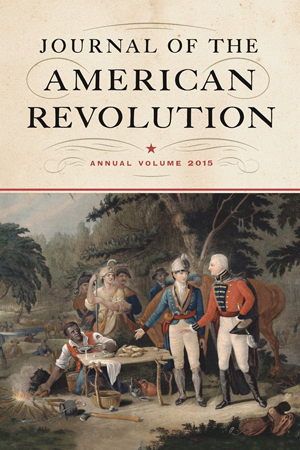
JAR2015_300x450The 2015 edition of the Journal of the American Revolution is now available for pre-order.

Every year, Westholme Publishing releases a reprint collection of essays that first appeared on the Journal website. This year’s volume includes my essay about the whaleboat raiding that occurred on Long Island Sound, where Patriots and Loyalists alike gave as good as they got:

“[T]wo boates crossed on the fourteenth instant,” wrote Caleb Brewster to New York governor George Clinton in the summer of 1781. “[They] went up about twelve at night to the houses of Capt. Ebenezer Miller and Andrew Miller, demanded entrance which was granted, as soon as the door was opened they demanded his arms which he gave up; his son hearing a noise below stairs got up out of bed shoved up the chamber windo. One of the party without ever speaking to him, shot him dead in the windo …”

During the Revolution, American Patriots employed a number of tactics to overcome their extreme disadvantage in the face of the overwhelming power of the British navy: a Continental navy, state navies, and privateers (some with Continental commissions and others commissioned by states). The whaleboat raiders — or “armed boats,” as they were called at the time — were a low subclass of the state-commissioned privateers, and as I point out in my essay, it’s questionable whether many of the raiders had commissions at all. In the chaos of war, the only equipment you needed to go robbing and pillaging on the opposite shore was a boat and some buddies, and if New England in 1776 was anything like New England in 2015 where every third house has a tarp-covered boat in its driveway, then this was not a high benchmark to reach. It probably attracted some men of dubious character.

The Annual Volume 2015 also includes essays from such notables as J.L. Bell, Benjamin Huggins, and JAR editor Hugh T. Harrington. Out in May, it makes a great Father’s Day gift!

The Fishers of Men

Black Static, January/February 2015I have a story in the January/February 2015 issue of Black Static:

There is no stopping progress. You may buy a plot of land, build a home, raise a family, join a church, and volunteer for the local PTA — but if the authorities determine someone somewhere else is thirstier than you, then they will drown your American Dream with no more effort than turning the spigot counterclockwise.

In 1936, when the Norris Dam was completed along Tennessee’s Clinch River, landowners in the century-old trade center of Loyston were relocated and the town submerged beneath the resulting lake. Neversink, New York, population two-thousand, was sacrificed to the waves of the Neversink Reservoir after the residents of New York City grew a little too dry in the mouth. When it was decided the right of a Boston Brahmin to flip his tap handle and fill his glass trumped those of plebeians living in Dana, Enfield, Greenwich, and Prescott, Massachusetts, the four towns disappeared beneath the Quabbin Reservoir. And upon completion of the Saville Dam along a branch of the Farmington River in 1940, the crossroads village of Barkhamsted Hollow, Connecticut — farmhouses, church, and cemetery — vanished underwater so that the citizens of Hartford might wet their lips.

I was a little shocked when Andy Cox accepted “Fishers;” it is a very American story and when I sent it I wasn’t sure the historical background would translate. But I suppose I don’t have to know the intricacies of lines of royal succession or the industrialization of Greater Manchester to enjoy M.R. James, Robert Aickman, or Susanna Clarke (to name the three most recent authors I’ve read), so perhaps the width of the Atlantic isn’t as great as I sometimes imagine.

On these western shores you can find Black Static at Barnes & Noble — though often a month or two after the magazine’s cover date.