A Connecticut County in Bill Penn’s Grant

Wyoming Valley by Jasper Francis Cropsey

I have a story at the Journal of the American Revolution about the absolutely true tale of Westmoreland County, a piece of northeastern Pennsylvania claimed by Connecticut as part of King Charles’s grant creating the colony:

The Susquehannah Company was founded in July 1753, when 152 subscribers adjourned in Windham, Connecticut to pay “Two Spanish Mill’d dollars” to join a new joint-stock venture. Declaring “Thatt Whereas we being desirous to Enlarge his Majesties English Settlements In North America and further To Spread Christianity as also to promote our own Temporal Interest,” their aim was to settle an area of the Susquehanna River beyond New York’s borders. … The Company proposed to settle at Wyoming, on the west bank of the river about 50 miles southeast of Tioga. Its clean soil and the scarcity of Native American settlements made it ideal to the Company members. More to the point, they believed the area was included in the Connecticut grant as per the 1662 charter.

I’ve mentioned before how, in the mid-aughts, I shopped a book idea called Lost States, detailing efforts at American state making that went pear-shaped. The book’s sample chapter, all 18,000 words of it, dealt with the first half of the Westmoreland story; this would have been followed by second and third chapters on the Republic of Vermont (using Ethan Allen’s involvement in the Susquehannah Company to segue into the conflict between New York and New Hampshire) and the resolution of the Westmoreland project. Lost States never went anywhere, and I very briefly sent around a proposal focusing solely on Westmoreland until I finally realized not everyone was as fascinated by the history as I was. Fortunately, the editors and readers at the JAR love this kind of stuff. My article is a distillation of that sample chapter.

Even today Westmoreland continues to mesmerize me, especially the religious angle. Was the Company’s obstinate refusal to take no for an answer a result of the New Light zealotry of its members?

Vaya con Dios

You may be aware that a few years ago, I began writing 19th-century alternate histories as a literary vacation after Smedley. The series soon morphed into a stream of weird Westerns, ghost stories, and even a little steampunk; while simultaneously their creation transformed into a kind of palliative during the Years of Real-Estate Madness. Distracted by garages, painting, buying, selling, and restorations (not to mention paying employment), my attention was too fragmented to think about more books or even short nonfiction with its relevancy demands and expiration dates. The great thing about short fiction is I can write something, walk away for weeks, and then come back to pick up where I left it.

In keeping with a theme of endings and new beginnings, it’s time for Strange Wests to ride off into the sunset as I readjust my focus toward longer projects and nonfiction. Nobody has been more astonished than me by Wests’s reception from editors and readers. A bunch are in various stages of the pipeline, which means there’s more to appear, and never say never: I’m happy to write fresh material as the inspiration or invitation strikes. Plus I’ve come to depend on fiction writing as an analgesic too much to quit it altogether. I will still be writing historical shorts as time allows, only these, for the immediate future, will be set in New England.

My goal is to bundle Strange Wests into an e-book collection to be published in 2015.

Freeloaders

It never ceases to amaze me as a professional writer how often I am solicited to write for free.

For some months I’ve been having a simmering dispute with a longtime market of mine over language (or lack thereof) in our contracts, and for a while I believed the matter resolved. Then this week it erupted again.

Without going into the nitty-gritty, the company basically said to me, Jackson, we’ve enjoyed your work so much all these years that instead of paying you, we want you to write for free. But don’t worry — if we happen to find any spare change under the couch cushions, we’ll think about sending some your way!

Unwilling to continue under their absolutely Mephistophelean terms, this past Wednesday I resigned in cold disgust.

Being a writer is like being a restaurant owner whose clientele is just as likely to sprint for the door, half-eaten burrito in hand, as to pay you. And yet while anyone — even the culprit, else why would he run? — recognizes dining-and-dashing as theft, no one blinks an eye at not paying a writer.

The writer, the artist, the photographer is the first to initiate the chain of commerce but the last to benefit from it, the first to act but the last to be paid.

The majority of my career has been spent freelancing and yet the bulk of my income has always been from web-related services, not writing. The few individuals I’ve known who wrote freelance full-time lived in near poverty. The gravest problem with freelancing is not the low pay — many jobs pay terribly — but the erratic or late payments, making it impossible to depend on them to cover bills (although Mrs. Kuhl is quick to point out that many companies suffer from late or non-payments; the difference is that bigger entities have the capital to ride it out or absorb the losses, whereas a freelancer — a company of one — feels the razor’s edge more sharply). Just ask this Columbia J-School grad, although for what it’s worth she can take solace in the fact I’ve run up much larger tabs than $1,200 with delinquent markets.

I am not a Harlan Ellison I-don’t-take-a-piss-without-getting-paid type but I believe in writing without payment in only two situations.

The first is if I’m promoting something — like, say, Smedley or an anthology I’m in. This is easy to double-check because generally the title of the thing I’m promoting is right there in the article. Whatever time and energy I’ve invested in such promotion is a marketing expense, a commercial sent across the airwaves that may, or may not, result in a sale of the thing. If I think my efforts have led to at least one ring of the cash-register bell, then I count myself ahead.

The second instance is when I’m trying to grow my platform or, to put it another way, promote my brand. Writing a personal blog pays dividends, if only to telegraph to readers that the cats haven’t started eating your corpse yet.

Where you have to be cautious is when you don’t own or control the content. There is a species of coprophage that will try to entice you to write “for exposure.” Any editor who uses the word “exposure” is a BS artist, because either their readership is too low for it to be worthwhile or it’s so big they could actually pay you in the first place. “Exposure” is the recompense offered by amateurs and thieves.

The big red flag is when an editor or publisher won’t pay but nonetheless charges readers for the content. A few months ago I was asked by an editor for permission to reprint an article of mine in an e-magazine she publishes for tablets and e-readers. The magazine is not free; in fact, its cost is comparable to other e-magazines on the market boasting much higher circulations. The only compensation offered was a link to my website. In sum, this editor is assembling a virtual magazine in her kitchen from contributions she hasn’t paid for — so her overhead is effectively zero — but charging a non-nominal price for subscriptions and single issues, and therefore all of the money she makes on the magazine is profit, or at least goes to pay the salary of her single employee: her.

Apparently, working for exposure is fine for some animals, just not for others.

Even if no money exchanges hands, I still have to question how much effort is spent growing my platform versus growing theirs. Frequently I’m asked to commit to regular contributions to other people’s websites. Half of me is flattered and the other insulted. Once in a blue moon I will scribble a post for John O’Neill at Black Gate, and even if my time is wasted doing so, based on what scant behind-the-scenes knowledge I possess, I can hardly complain I’m being taken advantage of. This type of writing is very dependent on circumstances and must be handled on a case-by-case basis, but my natural instinct is always in favor of my time, and hence the answer to regular contributions is always no, and to occasional articles a hard maybe.

While I wish the ending had been less acrimonious, I’m happy to have severed ties with the company. Installed in our gorgeous house with the renovations complete, Mrs. Kuhl and I feel that our lives are on a new trajectory, and we’ve been consciously embracing better habits and choices while simultaneously pruning dead wood.

I’ve been in this business long enough to understand there are rarely hard breaks or fast stops — writing is a series of waves, often overlapping, in which you write on a subject or for a market as it builds and crests but by the time it recedes, you are already surfing another flow.

LITCHerally the Best Guest Post Ever

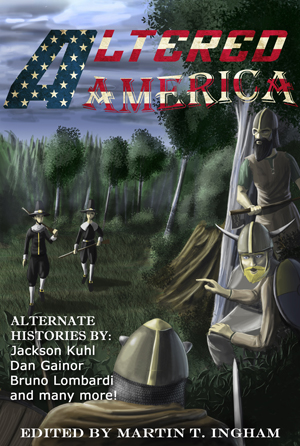
You're litcherally my favorite person!Matt Mitrovich asked me to write a guest post at Alternate History Weekly Update about my second forty-second career as an ebook-cover artist. I don’t think I’m qualified to write a how-to article on tying shoelaces let alone designing ebooks, but I scribbled some criteria and design ideas for his readers anyway. Matt has been phenomenally helpful in promoting Altered America, which in turn played a large role in its sales spike a few weeks ago.

Rereading said post, I find its upbeat tone almost unrecognizable to me, particularly in the last graf. I’m a much different person than I was a few years ago. A big part of that is due to our house, which is very near completion (the last contractor finished today). It has been a transformative 11 months. I’ve become even more Ron Swansonish about institutions — banks, insurance companies, governments — but more Chris Traegerish about individuals. Throughout the process, so many faceless bureaucracies were lined up against us yet our skins were saved time and again not just through our own tenacity, but also because of the effort and understanding of all the people who’ve worked on the house or supported us. If I go through the day without having to extinguish some kind of brushfire crisis — What’s that? You’re NOT cancelling my homeowner’s insurance for arbitrary reasons? Hooray! — then it’s a great day. I think that optimism has spilled over to how I feel about others and their projects and ambitions.

Down on the Rio Grande

Altered AmericaMy story “Rio Grande” appears in the new alternate-history anthology, Altered America. Gambling gunfighter Lorenzo seeks vengeance against a card sharp in the Republic of the Rio Grande, an independent country based on the economic principles of Frederic Bastiat:

“When the Republicans defeated the Mexican army at Morales, everyone knew it was only a matter of time before Mexico tried again. They realized our little breakaway estado could only be held by force. Force means men. So they encouraged homesteading to grow the population. They tried various policies for a few years but nothing worked. Everyone wanted to go to California instead. Finally President Jordan discovered the writings of a French philosopher named Bastiat. This philosopher advocated free exchange. No taxes. No tariffs. No customs. A strictly confined government. ‘Law is organized justice,’ said the philosopher — anything beyond that is perversion. So they scrapped everything and started over with a new constitution based on his writings and principles. They advertised it in all the eastern newspapers. Cheap land. Live tariff free. Women can vote. And where there are women, there are men and soon enough children who grow up to defend against Mexico. Then there weren’t enough branches in the trees to beat back the settlers.”

“But how do you pay for the judges and the marshals? Who builds the courthouses?”

“The philosopher wasn’t against taxes so much as their unfair and arbitrary application,” said Valasquez. “So to keep everyone honest, there are none to begin with. Citizens can make donations. But that’s exactly how Jordan managed to convince his caudillo supporters to agree to the constitution. It meant only self-sufficient people could afford to be judges and marshals.”

“Only the wealthy, you mean.”

“How is that worse than America?”

Alien Space Bats maybe, but I’ve often wondered why banana-republic rebellions usually take such a distinctly left-hand turn. The answer, I suppose, is Marxism’s empty pledge to eliminate the elite classes, a mistake based on the assumption that class derives from economic systems rather than being a natural by-product of state-level civilization.

In any event, “Rio Grande” isn’t for or against libertarianism so much as it is a stab at that most pernicious of modern ideologies, utopianism. Earlier this week at Reason.com, author Anne Fortier noted the power of historical fiction:

To the freedom-friendly novelist, one further advantage of historical fiction is that the entire history of mankind is jam-packed with tragic examples of what Hayek called “the fatal conceit” and the corrupting effects of power — especially state power.

It’s worth reading her whole essay, though I’m not sure what business Fortier has throwing speculative fiction under the bus after writing a whole book about a mythological matriarchy (for all of her self-satisfaction, it seems Fortier hasn’t learned that genre — the difference of where you’re shelved in the bookstore — is simply packaging). But she’s right: history shows that power disparities are inevitable once a certain complexity of social organization is reached, and the key is not a false promise of eradicating those disparities but rather blunting power so that it does the least harm.

You can purchase the whole anthology here — I’m happy to report the Kindle edition has seen a steady burn of sales since its release — or read my complete story for free here. And if you enjoyed the antho, please leave a review at Amazon or Goodreads.