
Mrs. Kuhl’s attendance was required at a conference in Boston, so the boys and I tagged along to experience Patriots’ Day, enjoy the museums, and give what support we could to the marathoners.
We arrived Sunday afternoon and parked in the Copley Square area. The boys like visiting the original Newbury Comics, and afterwards we walked over to the New Balance store on Boylston where I bought a pair of 990s. There’s a special kind of voltaic excitement generated by a big race and though neither of us was registered, it was energizing to be around the runners in their blue-and-yellow windbreakers, collecting their bibs and convention swag in their yellow Adidas bags. We walked past the finishing gate packed with people taking their pictures underneath, past the empty stands, to the store directly across from Copley Square. Runners were buying last-minute necessities — gloves were in hot demand. We wished anyone and everyone good luck. Afterwards we walked through the square, past the white tents and office trailers to the car.
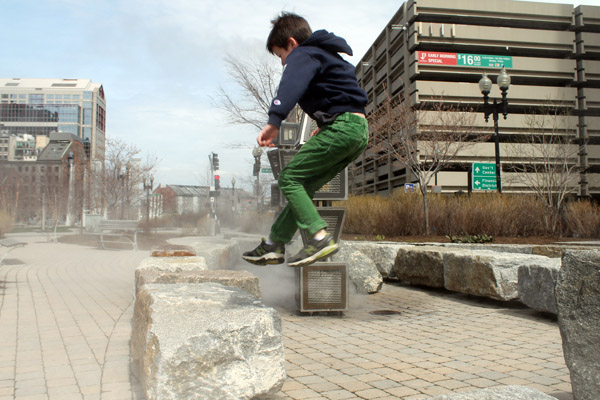
All the boys wanted from the trip was to parkour Boston — which, it must be admitted, is a very parkourable city. So Monday morning the boys and I parkoured or walked, as the case may be, over to the Old North Church to see the reenactment of Paul Revere’s ride to Concord.

After lunch at Quincy Market, we parkoured down the Greenway to the Children’s Museum.
It was right after we had gone back to the hotel for a swim when the Twitters alerted me to the bombings. I left the traceurs with Mrs. Kuhl, strapped on my serious sneakers, and black-smoked over to photograph what I could.
I love Boston; it’s so much more navigable and compact than, say, New York. I can blink my eyes and go from the Aquarium to the corner of Commonwealth and Dartmouth, almost two miles away. Runners in their foil wraps streamed down Marlborough, away from the square. None looked especially hurt or traumatized.
Commonwealth and Dartmouth was cordoned off but I backtracked to Clarendon and then through judicious use of the Public Alley, which parallels Newbury, and a private alley, which goes perpendicular, arrived at Newbury and Dartmouth, deserted except for police, a Fox 25 van, and just a few passersby. I spoke to a man coming out of his girlfriend’s apartment building on the corner. He said they had heard an explosion which shook the walls. They were running to the window when the second occurred, within seconds of the first. They stood and watched as people shuttled survivors, some with their limbs gone, along Boylston in the wheelchairs intended for exhausted runners. He said there was a lot of blood. He was clearly very shaken by what he had seen.
The cops manning the barricades had no information, so again I backtracked to Berkeley, where I merged with the general marathon bustle. The runners’ bags were laid out, ready to be retrieved.
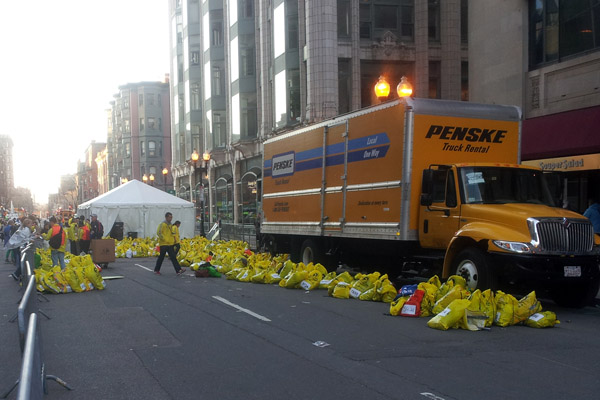
From there I made my way south, west, and north to arrive in Copley Square itself, behind the barricades and next to Trinity Church. It was empty except for a few police and EMTs. I toyed with the idea of continuing to Boylston to photograph the damage. But I reasoned there wasn’t much to see beyond carnage and gore, and it would be distracting to investigators if they had to chase after some jackass who had, somewhat unintentionally, penetrated a hole in their perimeter. I never know if I’m taking too many pictures or not enough. So I walked south on Dartmouth, slipping outside the barricade, to Stuart.

I hung around the area, asking questions, but nobody knew anything. At one point my phone service died; people said police had turned off cell service to prevent remote detonations, but as we later found out, it was because the systems crashed from overuse. I went to a hotel and charged my phone while riding their wifi. I returned to Dartmouth and Stuart. Emergency vehicles continued to zoom around. State police arrived. Police in camouflage and tactical gear jogged along the street. A finisher, silver cape clutched at her throat, discussed her experience.
I don’t wear headphones when I run, she was saying. I like to be alone and just listen to my body.
Runners. We are all prophets in the desert of the mile.
Eventually I headed back to my hotel, through the banana peels and foil tumbleweeds and garbage of a marathon’s end zone, past cops armed with rifles on street corners, past at least a dozen Mass State Police assembled in front of the State House.

So what does this mean for road racing? For big races like marathons? Bystanders segregated from the course? Security in and out of start/finishing areas, photo IDs, no more garbage cans? Do you know how much trash runners create?
Three dead, over a hundred injured, at least one double amputee — I don’t want to diminish the pain and sacrifices endured by the survivors. But at the same time, I don’t want to give the attackers too much credit. Without listing the reasons why and thereby granting column inches to the latest issue of Inspire, this could have been much worse. The culprits clearly know nothing about road races, and that same ignorance will probably hoist them on their own petard (the FBI has already received thousands of photos from the most photographed fifty yards of the entire course). The explosives appear to be fairly primitive — IEDs, or as a maritime historian might call them, deck sweepers — made with easily procurable components. I suspect that when they catch them, the bad guys will turn out to be one or two men, Faisal Shahzad types: that is, low-level jokers (Shahzad himself, who badly wanted to join jihad, was rebuffed by al-Qaeda affiliates in Pakistan because they thought he was an American spy; they finally gave him basic bomb-making training just to get rid of him). I mean, who thinks they’re going to provoke mass casualties by attacking marathoners? They already have the constitutional fortitude to run over 26 miles. Can you imagine? Half-crazed with euphoria and agony, heads full of endorphins and testosterone, if the police hadn’t ended the race, the wounded would have dragged themselves across the finish; meanwhile the runners halted at Kenmore, even after being told there was a chance of more bombs, still would have proceeded straight into the maelstrom. Look at the video. The explosion occurs and the runners don’t stop.
Because they’re tougher than you.
Put another way: this is no conspiracy orchestrated by some Saudi Fu Manchu in a Pakistani compound. Foreign or domestic, Islamist or lone wolf, the person or people who did this believed it would be bigger than it was. It was an unsophisticated plan using simple methods by outliers looking for attention, for whatever reason. The devil’s best friend, someone who offended all — this was done by losers. Losers hate winners. And anyone who crosses a marathon finish, regardless of their time, is sure as hell tolerant of pain and surprises.
Which is why the 2013 Boston Marathon shouldn’t affect road races. There is no insulator conceived that can dampen the electricity coursing through runners’ veins. Don’t fret about the garbage cans, throw away your bag checks. We’ll show up anyway, bibs safety-pinned to our shirts and singlets, ready to bend and flow over the landscape. Keep your hassles. Mrs. Kuhl is already planning to run Boston for charity in 2014. I’m registered for a few races this year; after Monday, I intend to add more. A bunch more.
Good luck, Boston. Love you. Stay safe. Blue and yellow.
London: kick ass this weekend.
 Mrs. Kuhl expressed surprise upon seeing the fantastic cover of this month’s Calliope, in particular to the “POWs Meet Their Captors” blurb. The story examines three different experiences during World War II: those of German POWs in England, German POWs in the US, and of Japanese-Americans in American internment camps. Her shock is why I adore Calliope — it’s not the pablum like Time For Kids they shovel at my sons’ school.


 Tomorrow night — Thursday, February 21 — I’ll be speaking about Samuel Smedley, Connecticut Privateer at the
  The theme of February’s